
Maintaining Energy Security as New Technologies Reshape the Grid: Emerging Threats, Potential Mitigants
Authors: David Ehrhardt, Mark Lambrides, Sarah Thomas
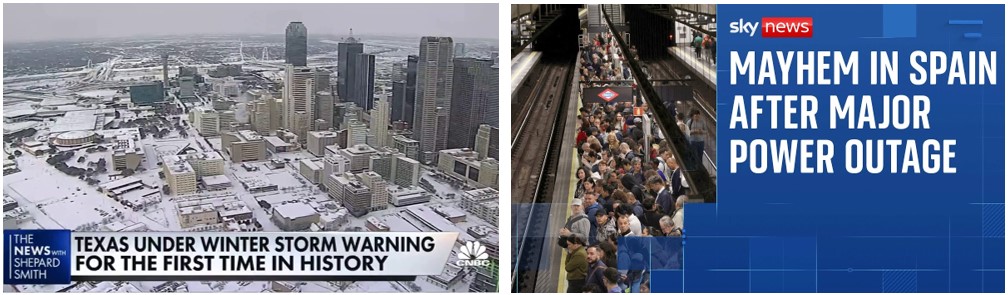
As inverter-based resources (IBRs) and large electronic loads reshape the grid, new risks and opportunities are emerging. System-wide outages—including Texas’s 2021 polar vortex-induced outage and the 2025 blackouts across Chile and the Iberian Peninsula—raise the question: can the grid keep up?
New technologies present opportunities and risks for energy security
As supply-side technologies scale, planning must keep pace.
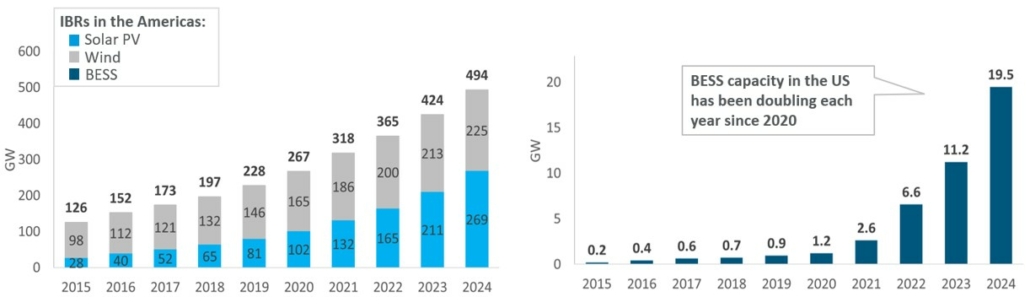
Across the Americas – from Canada in the north to Chile in the south – solar energy capacity increased ninefold and wind capacity doubled between 2015 and 2024. In the United States, battery energy storage systems have (BESS) been doubling in capacity each year since 2020. While these gains are largely positive for affordability and emissions, inverter-based resources (IBRs), such as solar and wind, are intermittent and non-dispatchable, and do not provide the inertial frequency support that spinning turbines in conventional power plants offer. This raises concerns about dependable capacity during high-stress periods on the grid.
Demand from large electronic loads is rapidly growing.
Electricity use from data centers accounted for about 4.4% of total U.S. electricity consumption in 2023 and is projected to rise to as much as 12% by 2028. Globally, data center demand is expected to nearly triple within five years. In Texas, cryptocurrency load accounted for about 3% of peak demand in 2024. Globally, electricity use from Bitcoin mining has roughly tripled over the past five years—now exceeding the total electricity consumption of Thailand. In California, electric vehicles (EVs) accounted for about 3% of total electricity demand last year and are projected to grow exponentially. Globally, EV-related electricity demand is expected to quadruple by 2030.
Taken together, large electronic loads—often fast-ramping and unpredictable—and EV charging at scale put the power grid’s reliability at risk, particularly if electricity supply and delivery capacity do not increase substantially over the same period.
Canaries in the coal mine: power systems are breaking and exposing new fault lines
Texas reserve margins are being squeezed by rapid growth in large electronic loads, as conventional power plants retire and IBRs surge.

In Texas, IBR capacity has roughly tripled since 2020, and now makes up 50% of installed capacity. More than 7.3 GW of coal and gas has retired since 2018. The Electric Reliability Council of Texas (ERCOT), Texas’s grid operator, has been directed by the Legislature to ensure reliability. Yet ERCOT’s own planning shows reserve margins already below target and projected to fall to less than 40% of the target by 2029.
A transmission line failure left more than 90% of Chile in darkness.
On February 25, 2025, Chile experienced a near-system-wide blackout after inadvertent protection relay operations tripped both circuits of a key 500 kV transmission corridor, causing parallel 220 kV lines to trip and splitting the grid into two electrical islands. The southern island collapsed within seconds due to a rapid frequency decline, while the northern island remained online for about four minutes before collapsing from an inability to control voltage, a potential consequence of IBRs not providing fast voltage control. Solar and wind have, at times, surpassed 40% of Chile’s generation mix and regularly supply over one third—a figure that has more than doubled over the past five years, with most variable-renewable energy (VRE) capacity concentrated in the northern region where the outage began. The collapse cut power to roughly 19 million people across 14 of 16 regions, halted major copper mines, shut down Santiago’s metro, and led the government to declare a national emergency, deploying over 3,000 troops and imposing a nationwide curfew. Restoration was slowed by the loss of communications and unsuccessful attempts to draw support from Argentina’s SADI interconnection, revealing deeper system vulnerabilities in Chile’s rapidly evolving, high-VRE grid.
The Iberian Peninsula was blacked out in less than 60 seconds.
On April 28, 2025, VRE accounted for over 70% of generation in the Iberian grid, and synchronous support was limited when frequency deviations began in Spain (see the figure below for a detailed timeline of events). With high VRE output, low inertia, and faulty ride-through and protection settings, frequency and voltage instability spread faster than operators could respond, resulting in a power outage affecting more than 50 million people. Over the course of the 10-hour blackout, Spain lost an estimated $1.82 billion in gross domestic product, streetlights stopped working, and over 100 trains carrying about 35,000 passengers stopped mid-track. Hospitals operated on limited generator capacity, and eight people died as a direct consequence of the outage.
Next steps? Targeted system and technology-level solutions can mitigate risks and stabilize reliability
System-level
Market design should ensure that dispatchable capacity and essential system services (e.g., fast frequency response, voltage control, etc.) are actually procured. In Texas, the current energy-only market may not meet the new reliability standard, which could trigger a formal market reform process. Similarly, Ireland is introducing reforms after rapid growth in data centers has put pressure on the grid and its capacity market failed to procure sufficient capacity.
Technical codes should be updated to enable IBRs and storage to provide grid-supportive functions. After Winter Storm Uri in 2021, Texas strengthened grid code provisions to address risks such as subsynchronous oscillation and torque amplification; similar code updates can improve system reliability elsewhere.
Cross-border interconnections lower costs and share risk by allowing regions to access the least-cost and dispatchable resources. During the 2021 Texas winter storm, interconnection with surrounding regions could have prevented approximately $1 billion in damages. In South America, ongoing efforts to interconnect, including Chile’s October 2025 announcement to pursue negotiations with Bolivia and Peru, are designed to reduce risks, while enabling more renewables and greater access for individual countries. The Central American grid (SIEPAC) has contributed to greater reliability and lower energy prices for the interconnected countries.
Technology-level
Smart infrastructure, such as grid-forming inverters, can enable VRE to stabilize the grid rather than destabilize it, and hedge against risk.
Adding inertia and flexible backup power is necessary as power systems, such as the Iberian grid, increasingly rely on VRE. Technologies like BESS, hydro-power plants, and synchronous thermal generation, such as gas turbines can fill these gaps, strengthening grid stability.